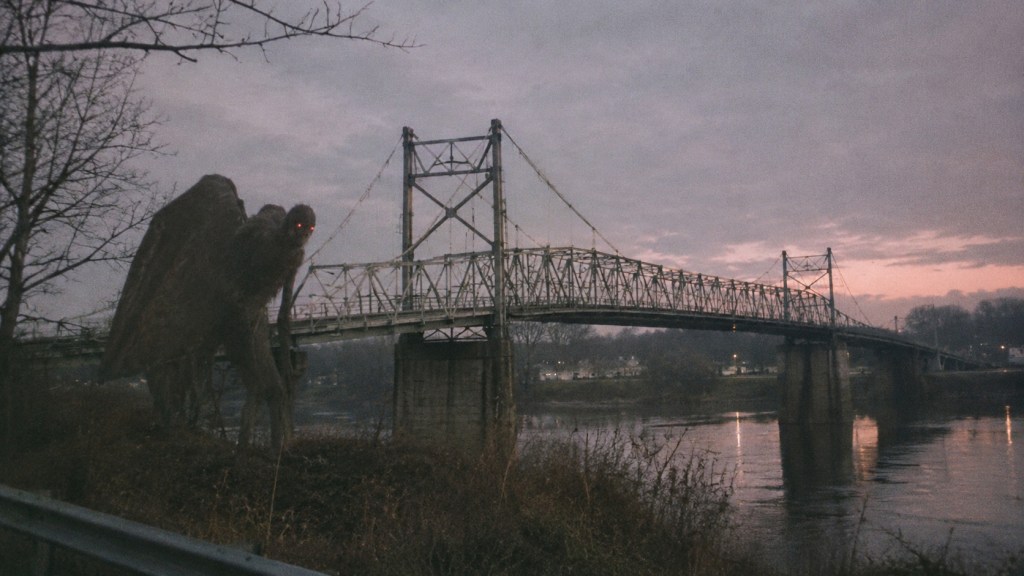
In 2002, The Mothman Prophecies brought one of America’s strangest urban legends to the big screen. Starring Richard Gere, the supernatural thriller explored mysterious sightings, disturbing telephone calls and apparent warnings of an approaching disaster.
The film culminated in the collapse of the Silver Bridge, a real tragedy that claimed dozens of lives in Point Pleasant, West Virginia, in December 1967.
But perhaps one of the most intriguing details came after the film had ended.
Its closing title card claimed that the ultimate cause of the bridge’s collapse was never determined.
There’s just one problem with that statement.
Investigators had already established why the bridge collapsed, more than thirty years before the film was released.
So why did The Mothman Prophecies leave audiences with the impression that a solved disaster remained a mystery?
On 15 December 1967, a tragedy occurred that would forever be etched in the memories of Point Pleasant’s residents. Spanning the Ohio River stood the Silver Bridge, which had opened in 1928 and allowed motorists to travel between West Virginia and Ohio. Almost forty years later, the bridge would collapse during rush hour, sending vehicles plunging into the river and onto the riverbank, killing 46 people. Investigators eventually traced the cause to the failure of an eyebar in one of the bridge’s suspension chains. A minor flaw had developed over the years through stress corrosion and corrosion fatigue. The National Transportation Safety Board published its final findings in 1970.

Perhaps one of the most significant differences in the 2002 film was that the disaster was portrayed as occurring on Christmas Eve. The film also reported that 36 people had perished instead of 46, and used the Mothman legend as a way of warning the characters of impending doom. Before the end credits begin to roll, the final title card explains that the cause of the Silver Bridge collapse was never determined. Well, evidently, that isn’t true.
For those who know little or nothing about the real disaster, it might feel quite spooky to “learn” that the bridge collapse was a complete mystery. The Mothman Prophecies is a film that seems convincing enough to make audiences believe what it tells them, largely because of its mature approach to storytelling. It isn’t the sort of horror film that relies on cheap scares. Nor is it the type of movie that could be described as fun to watch, and it certainly isn’t cheesy in tone. It deals with human loss, grief and how the central character attempts to cope with those experiences. So, I think it would be rather easy to be fooled by what the film tells you.
By now, I’m sure you’re wondering why the people behind The Mothman Prophecies chose not to tell audiences what really happened. While we cannot know their precise reasoning, director Mark Pellington offered some insight into his approach to the film in a January 2002 interview with the Los Angeles Times. He described ambiguity and unanswered questions as central to its appeal, stating: “That was the appeal to me, the ambiguity and the unanswered questions.” He also explained that the filmmakers wanted to avoid melodrama and anything overly eccentric.
From those comments, we can get the impression that The Mothman Prophecies was mainly a film that asked questions, but never necessarily answered them. And perhaps that approach extended even to a tragedy that already had an established explanation.
If you think about it, it might have seemed a little strange, and perhaps even weakened the movie, if it had given audiences a straightforward explanation for the Silver Bridge collapse. After spending nearly two hours watching mysterious events unfold, viewers would suddenly have been presented with a rational explanation for the disaster. They might have walked away feeling that the ending undermined the general atmosphere of the preceding events.
An explanation could have disrupted that feeling of the unknown. It might have broken the spell that the film had worked so hard to create.
So, even though The Mothman Prophecies doesn’t strictly stick to the facts, it still makes for a great fictionalised story inspired by the strange events surrounding Point Pleasant, West Virginia, all those decades ago.
The Mothman legend itself is still very much a mystery. Suggesting that there was no official explanation for the bridge collapse only adds to that, even if liberties were being taken with the facts. The mystery and atmosphere are what make the movie so memorable.
Perhaps that’s the greatest irony of all. The filmmakers didn’t need to invent a mystery surrounding the Silver Bridge disaster. The Mothman legend already provided one. Yet by presenting a tragedy with a known cause as something unexplained, they ensured that the mystery extended beyond the creature itself.


Leave a Reply