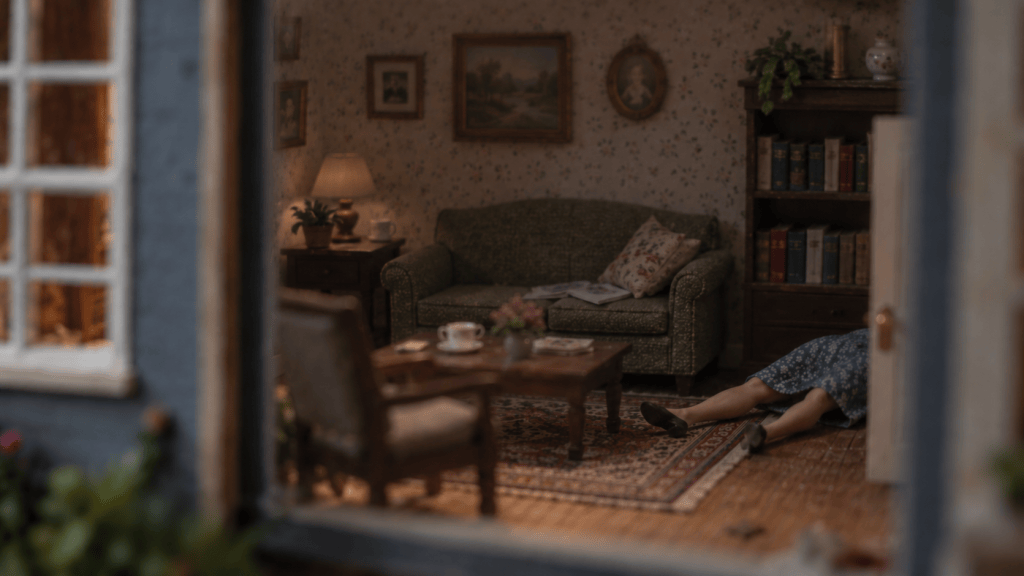
You notice the wallpaper first. Perhaps the tiny furniture, the picture frames, or the remarkable attention to detail in a room small enough to fit inside a shoebox. Then you spot the body.
It’s an odd contradiction. Everything about a doll’s house suggests something harmless, perhaps even comforting. Yet some artists deliberately transform these innocent-looking miniature worlds into scenes of murder and violence.
The results can be strangely fascinating, but also deeply unsettling. After all, these are objects we normally associate with childhood, not violent death.
And perhaps that’s what makes these miniature crime scenes so peculiar. They take something familiar and comforting and transform it into something we would ordinarily rather look away from.
Why does something so small and apparently innocent become so unsettling?
Artist Abigail Goldman, a former crime reporter, has also worked as an investigator for the Federal Public Defender in Nevada. Her miniature crime scenes, known as “dieoramas”, have been exhibited internationally. Using tools such as tweezers and a magnifying glass, she creates some pretty gruesome fictional scenes influenced by her professional experiences. In May 2026, she held a solo exhibition called I Hope This Finds You Well at Hashimoto Contemporary in New York City.
The exhibition offered examples of just how far she takes this contrast. In her miniature suburban worlds, neighbours mow over bodies and bury them in gardens. Elsewhere, housekeepers mop up bloodstained floors as though carrying out an everyday chore. The scenes are created at a scale of 1:87, making the violence perhaps even more shocking and jarring once you notice it.
Perhaps the most unsettling thing is that dolls and doll’s houses are objects we commonly associate with our childhoods. They symbolise innocence, playfulness and safety. So, when those same objects are used to depict situations many of us would rather look away from, they can create a real sense of discomfort. Is it the violence that’s disturbing, or the association with childhood?
I’d say it’s probably a bit of both, depending on who’s looking. But people are often drawn to what is peculiar, so it isn’t surprising that some enjoy studying work like this. The intricate details reward a closer look, while curiosity plays its part, even if you might call it morbid. And, much like watching a horror film, there’s a reassuring distance between the violence being depicted and the person examining it.
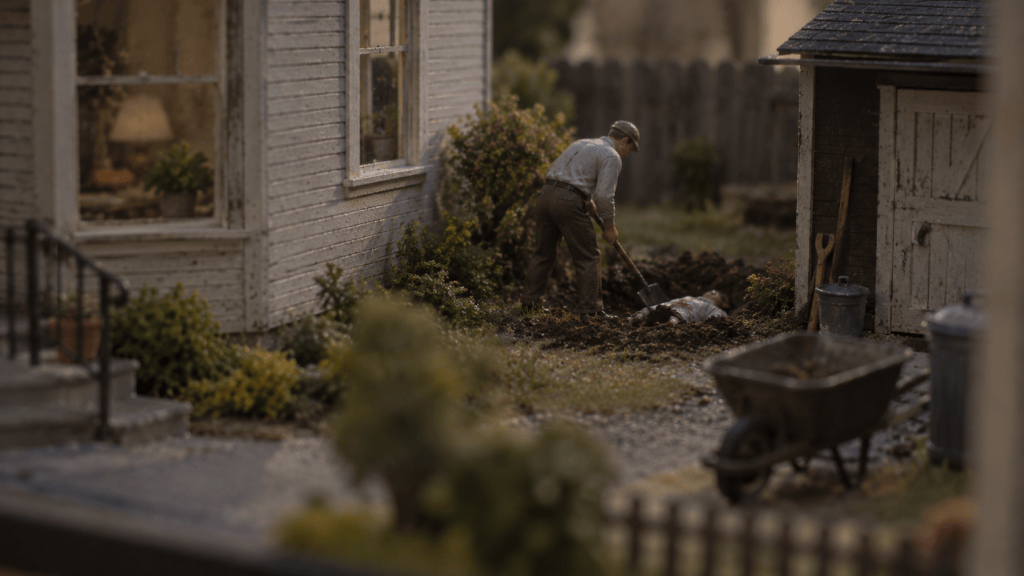
Goldman’s scenes also welcome viewers to piece together the story for themselves. They leave questions unanswered, encouraging people to look for clues and imagine what happened before the moment captured in miniature. In that sense, the viewer becomes something of a detective, despite knowing the entire scene was constructed by an artist.
Goldman has described her creations as both haunting and humorous. Importantly, she doesn’t recreate actual murders, regarding those tragedies as something that shouldn’t be turned into a joke.
Frances Glessner Lee, born in 1878, created 20 miniature death scenes to train investigators. Her Nutshell Studies of Unexplained Death drew on real cases but were not exact reconstructions of individual crimes. Although originally intended as teaching tools, her work is now also regarded as art, and surviving models are still used in forensic training. In 1943, Lee became the first woman appointed as a captain in the New Hampshire State Police, a position widely described as honorary.
Perhaps the most remarkable thing about these miniature scenes is how something so small can have such a powerful effect.
Whether created to investigate death or provoke an emotional reaction, they show how even the most innocent looking objects can reveal something deeply unsettling.


Leave a Reply