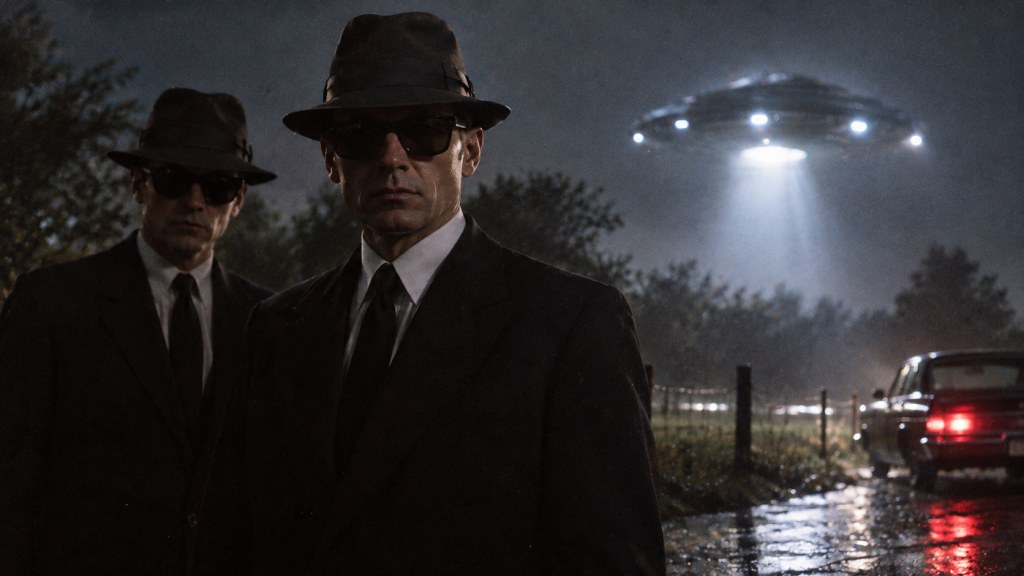
Why might an ordinary-looking man in a dark suit be more frightening than an unidentified object hovering in our skies? At first, the answer seems obvious. One is potentially extraordinary, while the other is just a person. Yet stories of the Men in Black suggest that the familiar can sometimes be far more disturbing than the unknown, particularly when it appears to know something about you.
Albert K. Bender ran the International Flying Saucer Bureau in Connecticut. In 1953, he abruptly closed the organisation, claiming that mysterious visitors had warned him to stop his UFO research. A contemporary newspaper report described three men in dark suits who allegedly displayed credentials. Bender also described them wearing Homburg-style hats.
But his account would become considerably stranger. Bender claimed that the men communicated with him telepathically, warning him to stop publishing his work. They allegedly took copies of his organisation’s newsletter, Space Review, and a cloud of yellow fog appeared upstairs in his home.
According to Bender, the Men in Black returned on several occasions. He also reported headaches, further telepathic messages and the unsettling feeling that he was being followed.
Herbert Hopkins was a doctor and hypnotist living in Maine in 1976. While investigating a reported UFO abduction case, Hopkins received a telephone call from someone requesting an interview. He agreed. Eerily, shortly afterwards, he noticed a man standing on his front porch.
The visitor wore a black suit, tie, shoes and hat, along with a white shirt. Hopkins was startled by the man’s unusually pale skin, which he described as almost artificial.
After discussing the UFO case, the stranger allegedly drew Hopkins’s attention to two coins in his pocket. Hopkins took one out and held it in his hand. According to his account, the coin became blurred before disappearing right in front of his eyes!
The visitor then supposedly told him that nobody on this plane of existence would ever see the coin again.
But perhaps the most frightening detail was the man’s appearance. Hopkins claimed that the stranger appeared to be wearing lipstick. When some of it rubbed off, he noticed that the man seemed to have no normal lips. Just a narrow slit where his mouth should have been.
The visitor also allegedly warned Hopkins against continuing his UFO investigations. Before leaving, he claimed that his energy was running low. When Hopkins looked outside moments later, the man was nowhere to be seen!
While many UFO abduction stories can strike fear into our hearts, I would argue that the alleged Men in Black are equally frightening, if not more so.

These supposed visitors have been described doing things that should not be possible. Making objects disappear, communicating without opening their mouths and sometimes behaving almost like robots. One even supposedly claimed that his energy was running low before leaving. Other accounts describe awful odours that could be left behind.
But in an attempt to keep our feet on the ground, there are some questionable aspects to these stories, particularly the Hopkins encounter.
A person identifying himself as Hopkins’s nephew later claimed that his uncle had a tendency to invent elaborate stories and seek attention. He also alleged that Hopkins struggled with alcohol during the 1970s and 1980s.
These are serious allegations, and they do not independently establish that Hopkins fabricated his encounter. Nevertheless, they give us good reason to question how much of his bizarre story can be trusted.
Gray Barker popularised the Men in Black legend in his 1956 book, They Knew Too Much About Flying Saucers. This raises another possibility: could the popularity of the stories themselves have encouraged people to interpret unusual encounters in similar ways?
We’ve seen how speculative ideas can become widely accepted through repeated exposure. One example is the popular claim that DMT floods the human brain at death and causes near-death experiences. Although the idea has been widely talked about, it has not been scientifically verified.
Could something similar have happened with the Men in Black? Well, why not?
We also have to consider hoaxes and deliberate deception. The Men in Black have all the ingredients needed to capture the public’s imagination: mysterious identities, threats and an apparent position of authority. Many of us are naturally drawn to things that lie outside what we consider normal.lse
But regardless of whether these encounters were genuine, exaggerated or entirely false, there is still something interesting about why they frighten us.
The Men in Black stories introduce a threat into the very place where we often feel most secure: our homes. They make us question whether we’re really safe anywhere.
Contrast that with seeing something mysterious in the sky. We might observe it for a few seconds before it disappears. We may spend years wondering what we saw, but that doesn’t necessarily mean we will fear for our own personal safety.
The Men in Black stories are different. They suggest that the mystery hasn’t ended with the sighting. Instead, someone knows what we’ve seen, knows where we live and may be watching us. At any time.
Perhaps that’s what makes them so frightening. A UFO is something we observe from a distance. The Men in Black turn that around and make us feel as though we’re the ones being observed.
And even after considering all the rational explanations, one unsettling question remains.
What if they’re real?


Leave a Reply